
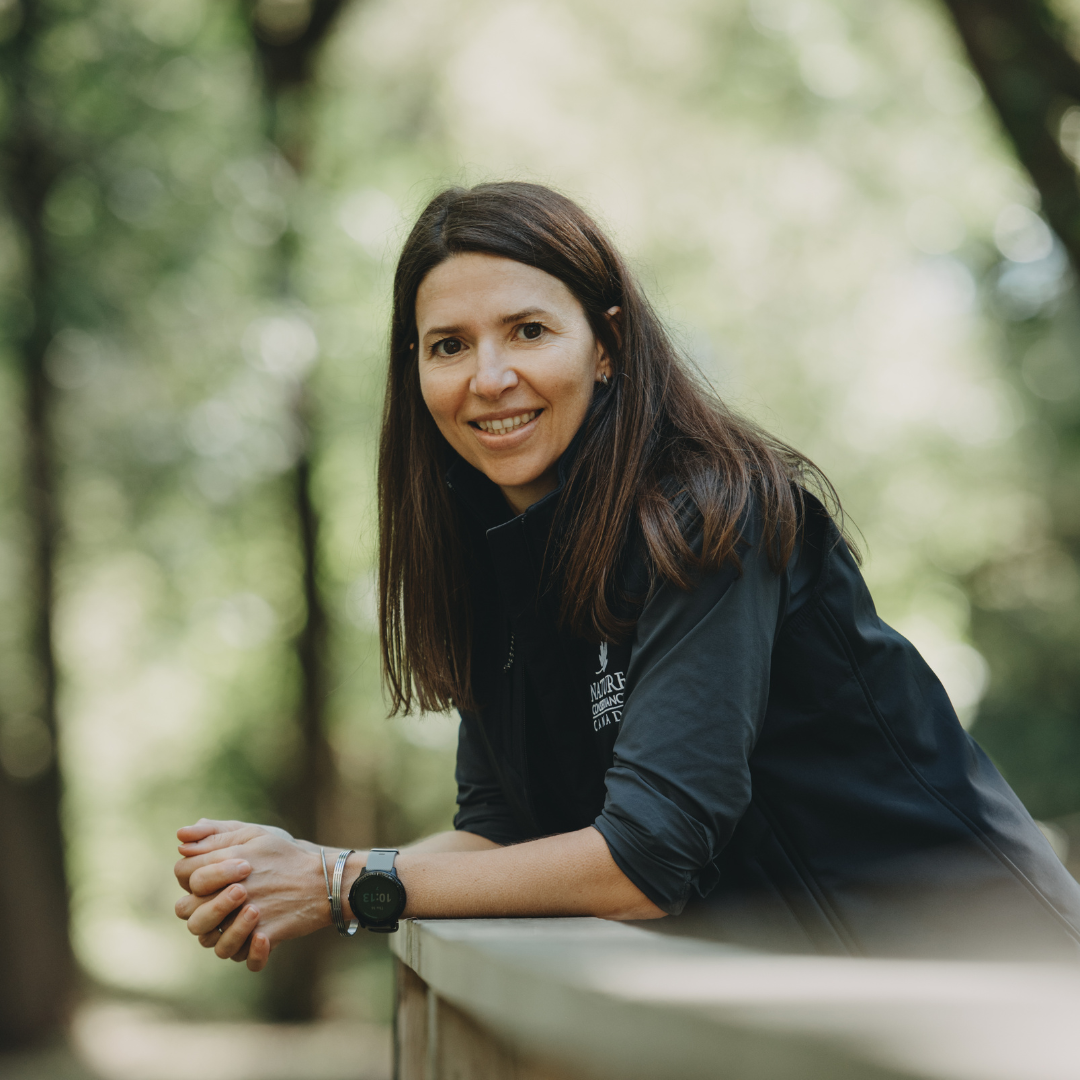
It was the love of winter sports that eventually led Catherine Grenier, the President and CEO of the Nature Conservancy of Canada (NCC), to realize she wanted to devote her life to preserving the great outdoors.
“I grew up alpine ski racing in the mountains, spending countless hours in the snow” she explains. In university, she found her “happy place running in the woods” and developed a passion for cross country skiing. When it was time to look forward to what she wanted to “do with her life,” Catherine says she realized “what I liked about sports was that it gave me time to be in nature.”
The ripple effect would lead Catherine to a career in conservation to the great benefit of Canadians. Today, under her leadership and using cutting edge conservation science and technology, the NCC has protected over 20 million hectares of habitats and ecosystems from coast to coast to coast. That’s roughly the size of the United Kingdom.
Because of this and her continued drive to save our greenspaces, Catherine has received multiple honours, including the Queen Elizabeth II Diamond Jubilee Medal and the Canadian Parks Council Award of Excellence. She’s also the 2025 RBC Canadian Women Entrepreneur Awards Social Change winner.
From Competitive Athlete to Conservation Leader
Catherine’s career in conservation began six years after university. She graduated from Carleton with a Bachelor in Public Administration and worked for Ski Quebec Alpin and then Loisir Sport Outaouasis.
While at the latter, she began her MBA at the Telfer School of Management at the University of Ottawa and stumbled on a role in partner engagement at Parks Canada. That position would lead to an almost decades-long career at the federal level, managing projects like establishing Canada’s first national urban park in Toronto’s Rouge Valley (“it was such a privilege to try to create something new”) and later, a role at Sépaq, the Québec government agency that manages parks and wildlife reserves. There, she oversaw projects like the development of 27 parks that drove a 40 per cent increase in visits to the province’s park network.
“I loved the intersection of connecting people with nature,” she says adding she was eventually drawn to a role at the Nature Conservancy of Canada because she saw an “ability to collaborate with organizations, individuals, governments, and communities who share common goals and can help achieve outcomes bigger than any one of them can deliver alone.”
Today, Catherine’s desire to protect Canada’s natural habitats and landscapes is unwavering. One afternoon during a family ski trip, Catherine’s son told her that their work in conservation was “helping to save winter.” For her, that was a big reminder of the importance of what she does and the impact it has on future generations.
“My work is very dynamic. And it’s very empowering in the sense that every day my team and I are moving the needle a little bit. We can look back and say ‘wow, these are results we can walk on.’ We can look at the map of the country and see where we’re actually making a difference.”
Building Vision Through Collaboration
A former coach, Catherine says her approach to leadership reflects her background in developing talent and potential. “If I were to reflect on what people would say, I think they’d say I’m a visionary leader. I can paint a very clear picture of what’s possible and then help people connect the dots in terms of how to get there,” she says. “I’m ambitious and set bold goals that will motivate people and help them believe they can achieve more than what they think is possible.”
As challenges arise (and Catherine says they’re abundant in conservation work), she says she does her best to keep things in perspective. “Taking a step back has always been very helpful for me,” she says. “I feel that if a door shuts, there’s always another way [to get something done].”
She also leans strongly on her values: “[No matter what the challenge is] you have to take the high road; you have to do the right thing; you have to lead with integrity. If you do that, your hard work will pay off. Sometimes [progress] may feel slow, especially in the moment, but it will always pay off.”
And Catherine says she’s worked hard to redefine the concept of work-life balance, especially as she’s a mother of two working in a role that requires extensive travel (“there’s no balance on a daily basis… but there is overall… it’s almost like there are seasons, and I really try to prioritize with deep intention… I understand that showing up when it matters is what’s important”).
When Catherine received the news that she’s one of RBC’s Canadian Women Entrepreneurs of the year, she immediately focused on the results of her team. “None of this is me. It’s all of us together. It’s the strength of the team, our generous supporters, partners, and the board.”
She also thought of her supportive network of peers, colleagues, and friends. “Sometimes I don’t have the answers, but I’m good at figuring out who will… picking up the phone and asking someone- who’s the best person in a sector or field for us to connect with?”
For those reading this piece who are looking to follow a similar path to Catherine’s – or to do work in the conservation space – Catherine offers up some pragmatic advice.
“Be comfortable working in the grey and don’t wait to have all the answers or feel completely ready, because you never will,” she notes. “Momentum gives you your next steps… as soon as you start moving and advancing, and have conversations with knowledgeable people, you learn from their advice, and then path to success becomes clearer.”
Vulnerability is key. “When leaders say it takes a village, it’s true in every aspect of life. People, particularly women, need to overcome the tendency toward perfectionism that can prevent them from asking for help.”
So too is taking a long-term view of things. “I’m always thinking, ‘five, 10 years from now, what will be important?’”
And perhaps most critically, she goes back to the importance of finding the kind of team that will support you in achieving your organization’s purpose – and who will carry on your legacy.
“I cannot do it all on my own, nor can I fulfil this mission on my own, but I am building a good team and good leaders that will continue this work. And because of that, because of our shared belief, we’re mobilizing more and more Canadians for nature. Our goal is to mobilize at least one million Canadians. We’re close to 700,000 now. Every new supporter gives me faith that way past my time, more people are going to care about and support the work that we do.”
How can you help? “The most concrete action you can take today to preserve our natural heritage is to volunteer your time or support financially what you can. Join a local land trust or an organization like the Nature Conservancy of Canada… time and money and support and ambassadorship is something that is within everyone’s reach.”