
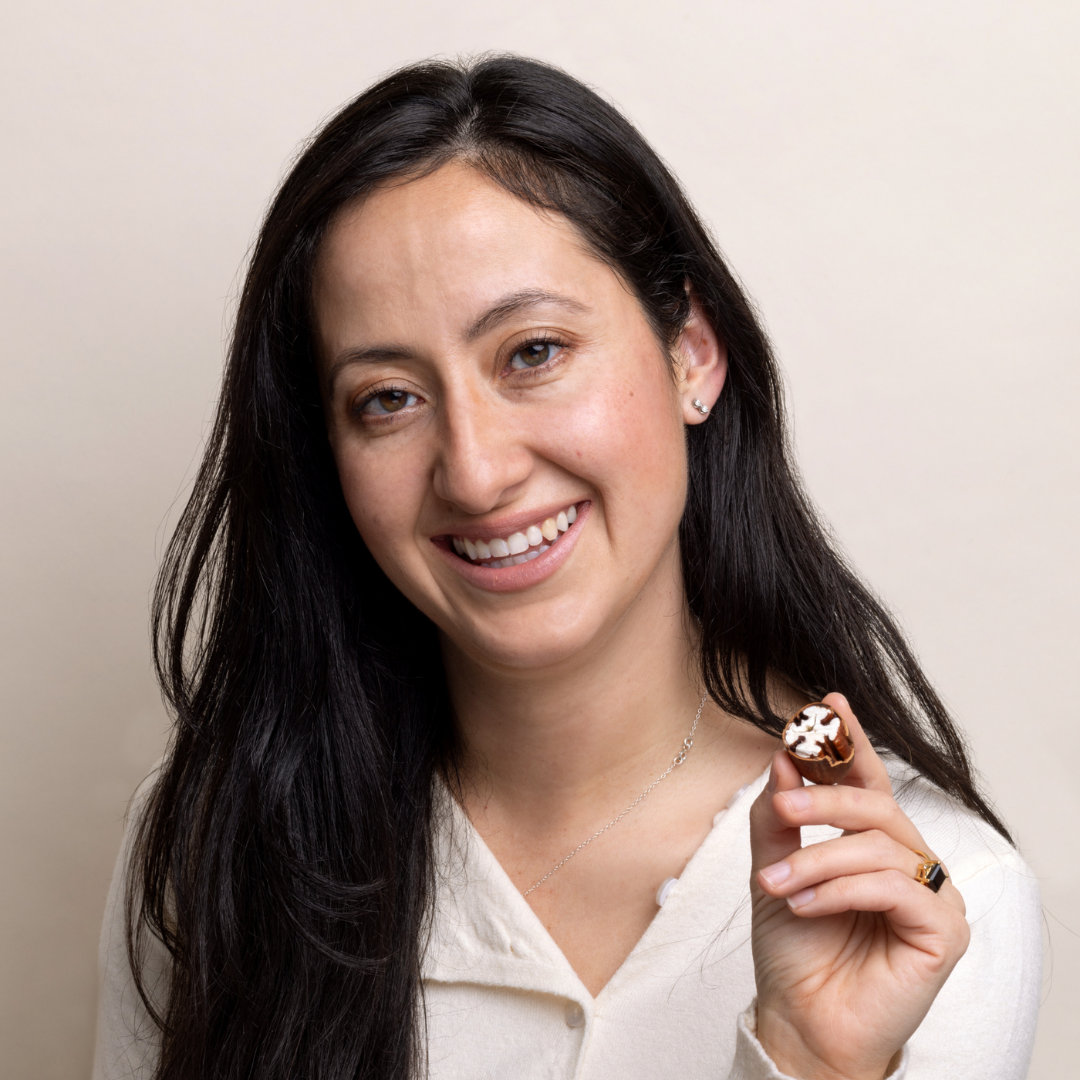
What if growing up with little water inspired you to create a beauty brand that uses none at all?
“I grew up in a desert. It rains maybe a handful of times a year. The rivers have no water… [and it] gets cut off around 2 p.m. because there’s simply [nothing left],” Nancy Wingham says of her childhood in Northern Mexico.
In her small rural town, there were no Walmarts, no fast-food chains – just family farms and tight-knit communities. Families who could afford it purchased water from private companies to fill their tanks. Those who couldn’t, went without when the municipal supply ran dry each afternoon.
For Nancy, water scarcity wasn’t an abstract concept – it was daily reality. That experience became the foundation of Nuez Acres, her waterless beauty company that’s redefining sustainable skincare.
From Pecan Farm to Beauty Innovation
Nancy is a fourth-generation entrepreneur who grew up on her father’s pecan farm, and watched him balance business success with community responsibility.
“I’ve seen everything from extreme success to bankruptcy,” she says. “I know there are cycles in businesses. There are going to be seasons where you’re doing extremely well and there are going to be times where you can’t really see the light at the end of the tunnel.”
What shaped her most was her father’s approach to leadership. “I remember having these conversations with him when I was a teenager,” Nancy adds. “I’d ask, ‘Dad, why don’t you buy a machine to increase productivity and reduce your labour cost?’ He would look at me and say, ‘Okay, I understand that, but who’s going to hire these people?'”
Nancy came to Canada originally to study English, fell in love with the country, and returned for university. At BCIT, she studied interior design and met Anthony – her Indigenous Canadian husband – while they both worked at White Spot. With her design background and his skills as a tile setter, they launched a small renovation company on Vancouver Island – their first company together.
By 2019, with one-year-old daughter Sophia in tow, Nancy found herself at a crossroads.
“I’ve always been really driven. I never saw myself as a stay-at-home mom.” As new parents, with no family nearby, she says she was “really thinking about the best way to raise a family” while maintaining their careers.
When Tariffs Sparked a Solution
During the first Donald Trump presidency, tariffs imposed on China caused pecan prices to collapse. Nancy watched her family and other small farmers from her community struggle to sell their crops.
“[Anthony and I] wanted to find a way to help them,” she says. “So we started looking to see if we could export pecans [to other places] around the world.”
But commodity price volatility made that challenging. That’s when Nancy and Anthony started to think differently: instead of selling raw pecans, what if they could add value to them?
Nancy’s parents brought five kilograms of pecans to Canada on their next vacation. The couple began experimenting on them, including with oil extraction, and sent samples to a Canadian lab for analysis.
“We found out pecan oil had all sorts of nutrients,” Nancy says. “[And realized the pecan] wasn’t really being used in the [North American] skincare industry, even though [where I grew up], [the nut is] known for its benefits for the skin and hair.”
The idea for Nuez Acres was born.
Building a Waterless Beauty Brand
How does someone with zero beauty industry experience build a skincare company? “We started small,” Nancy says. “We started with three SKUs, and right now we have 14.”
Nancy and Anthony taught themselves formulations through research and trial and error. When something didn’t work, they adjusted and evolved the products. In the process they stumbled upon an unsettling discovery: traditional beauty products contain massive amounts of water.
“The main thing we noticed is how much water is in a lot of products,” Nancy notes. Coming from a desert where “private companies sell water and then you have to purchase water and come and fill your tank,” the waste felt personal. Anthony’s knowledge of water crises in Indigenous communities across Canada made it even more urgent.
“To us, it was so important to create an impact, especially in this category, and maybe create some consciousness of the importance of water and water conservation.”
Nuez Acres launched as a fully waterless brand. Today’s products contain no water whatsoever – a rarity in an industry built on it.
More Than Skincare
Nancy’s business model extends far beyond environmental sustainability. She employs Indigenous women in Mexico, ensuring they’re paid well enough to stay in their communities rather than migrate for work.
“We’re not just a skincare brand. We’re trying to help communities,” Nancy says. “How do we build our business to support those communities and help them stay there, help them raise their families?”
She actively partners with non-profit organizations and has reached out to other RBC Entrepreneur Award winners about hiring immigrant women and single mothers in Canada. Even her now eight-year-old daughter Sophia gets involved (she designed one of Nuez Acres’ solid perfumes and regularly attends business events).
The balancing act isn’t always easy. Nancy has worked with a therapist to manage the mental load of entrepreneurship and motherhood. But she says it’s been worth it.
“My therapist always used to tell me, ‘If there’s an order that’s shipped late or you didn’t respond to that email, is there somebody dying?’ And I’d be like, ‘No, there’s nobody dying.’ And she’s like, ‘Then it’s not that big of a deal.'”
A Dream Realized
Nancy says winning the RBC Canadian Women Entrepreneur Micro-Business Award has validated all she’s done for her company over the years.
“It is a dream come true,” she notes. “I’ve seen so many women that I look up to be nominated and win the award. [As business owners] we focus so much on the day-to-day that sometimes we’re not able to see the big picture. This award really helped me step back and see the business and how far we’ve come.”
The recognition, she adds, has reinforced her belief in supporting women entrepreneurs.
“We as women have so many roles. It’s so important to feel supported, because if we are all in this together, especially supporting each other, then we can break glass ceilings.”
Her final advice? “Everything is possible. I came to Canada with $20 in my pocket. It’s not easy, but it’s possible [to accomplish your biggest dreams].”